A fortress that was never taken
Built to hold, not to impress
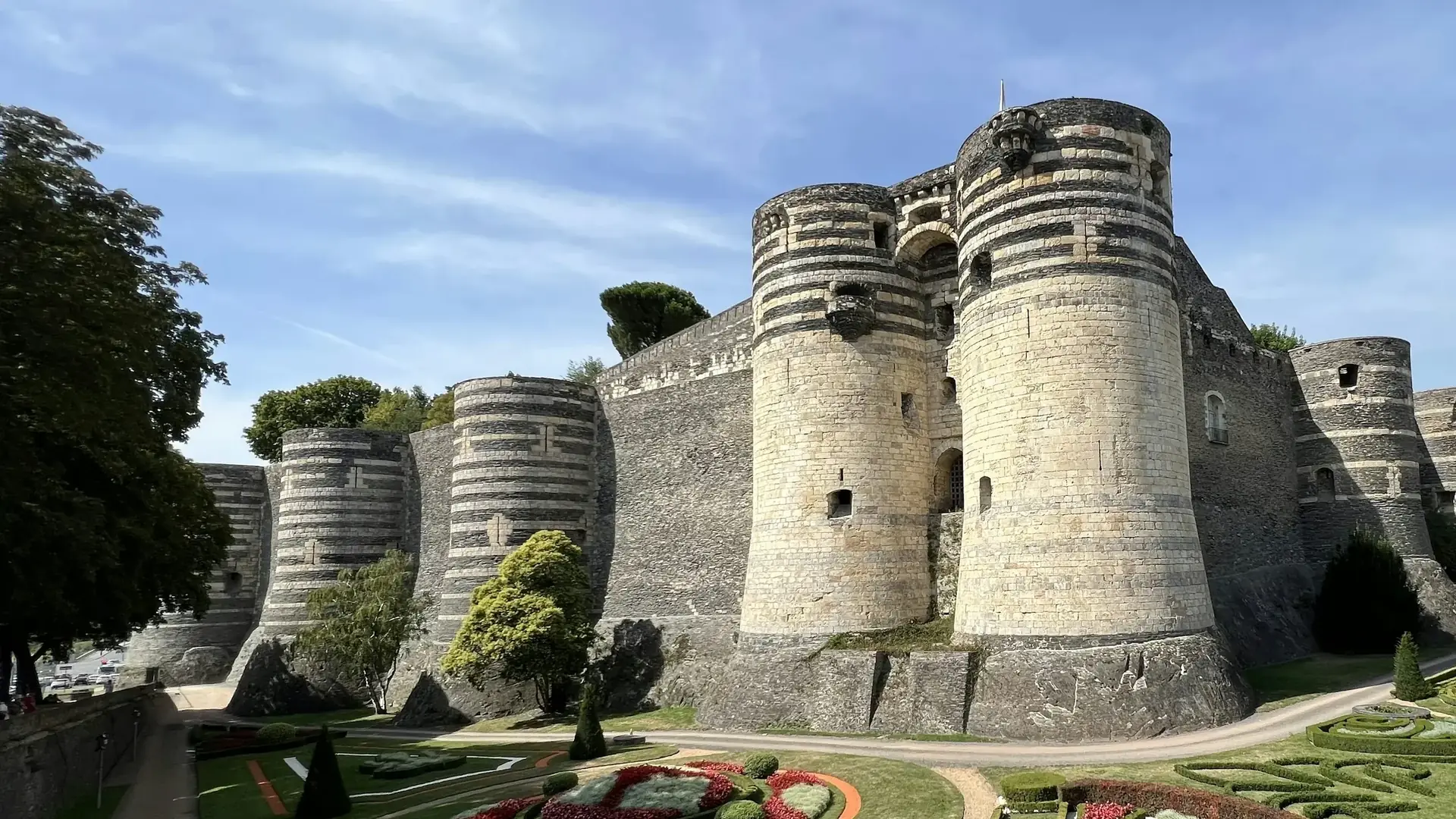
A stronghold stood on this rock above the Maine from the ninth century, but the fortress visitors see today took shape from 1234, when Louis IX — Saint Louis — ringed it with seventeen drum towers and a curtain wall roughly 660 metres around. Angers passed from the English crown to the French in 1204, and the new walls were built to make sure it stayed that way: the château was never successfully stormed.
A military academy, then two world wars
Long after its medieval role ended, a military academy was established in the château, and Arthur Wellesley, the future Duke of Wellington, trained at the military academy of Angers before the campaigns that ended Napoleon's rule. The fortress went on serving as an armoury through both world wars, and during the Second World War an ammunition store inside the walls exploded and caused serious damage; what stands today is the result of the restoration that followed.
A masterpiece with its own UNESCO honour
Angers lies near the western end of the stretch of the Loire valley, from Sully-sur-Loire to Chalonnes-sur-Loire, that is inscribed as a World Heritage site. The château's own UNESCO distinction comes from what it holds: in 2023 the Apocalypse Tapestry joined UNESCO's Memory of the World register, a programme for documentary heritage that is separate from the World Heritage List.
The Apocalypse Tapestry, in the order it tells the story
Louis I, Duke of Anjou, commissioned the tapestry around 1373 from designs by the painter Jean de Bruges (Jean Bondol); the work was arranged through the Paris merchant Nicolas Bataille and woven in Paris between 1377 and 1382. It was made as six hangings, each originally about 24 metres long and six metres high, telling the Book of Revelation in some ninety scenes. A little over 100 metres of it survives, shown in a purpose-built gallery within the fortress since 1954.
- The opening
The vision of Christ
The narrative opens with John's vision of Christ among seven golden lampstands, the vision that sets the whole Book of Revelation in motion.
- The seals
The seals and the four horsemen
A scroll sealed seven times is opened one seal at a time, loosing the four horsemen. The tapestry's Death is unusual for its century: a decaying corpse rather than a living rider.
- The trumpets
The seven trumpets
Seven angels sound seven trumpets in turn, each blast bringing a fresh plague down on earth and sea.
- The dragon
The woman, the dragon and the beasts
A woman clothed with the sun is pursued by a great dragon, while two beasts rise from the sea and the land to serve it.
- Babylon
The fall of Babylon
Seven bowls of wrath are emptied, and the city of Babylon, Revelation's emblem of worldly corruption, is brought down.
- The close
The New Jerusalem
The story closes on a city let down from heaven: the renewal promised after everything that came before it.
The gallery is kept deliberately dim to protect the dyes, so the sequence below reads better in person, scene by scene, than in any photograph.
Behind the walls
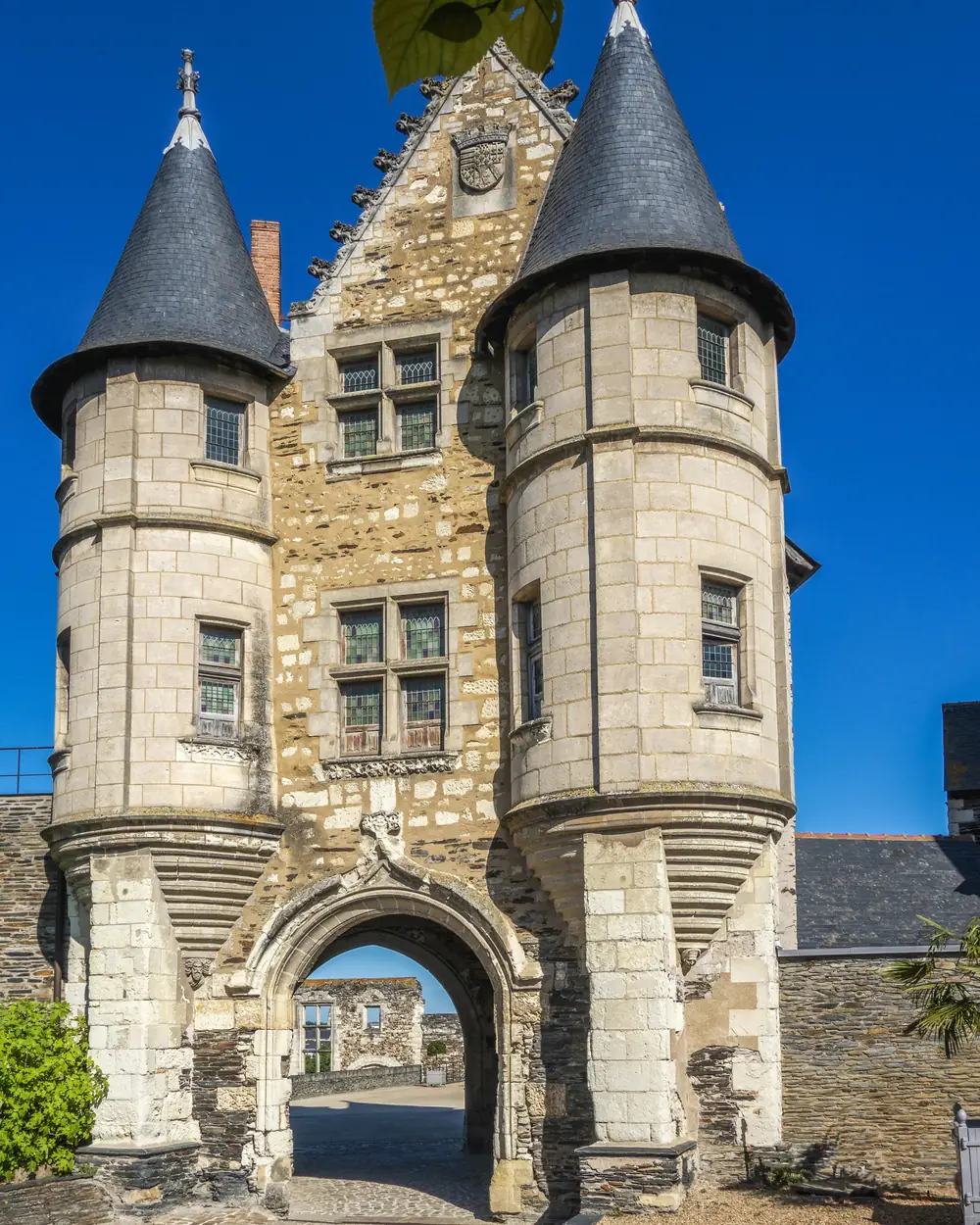
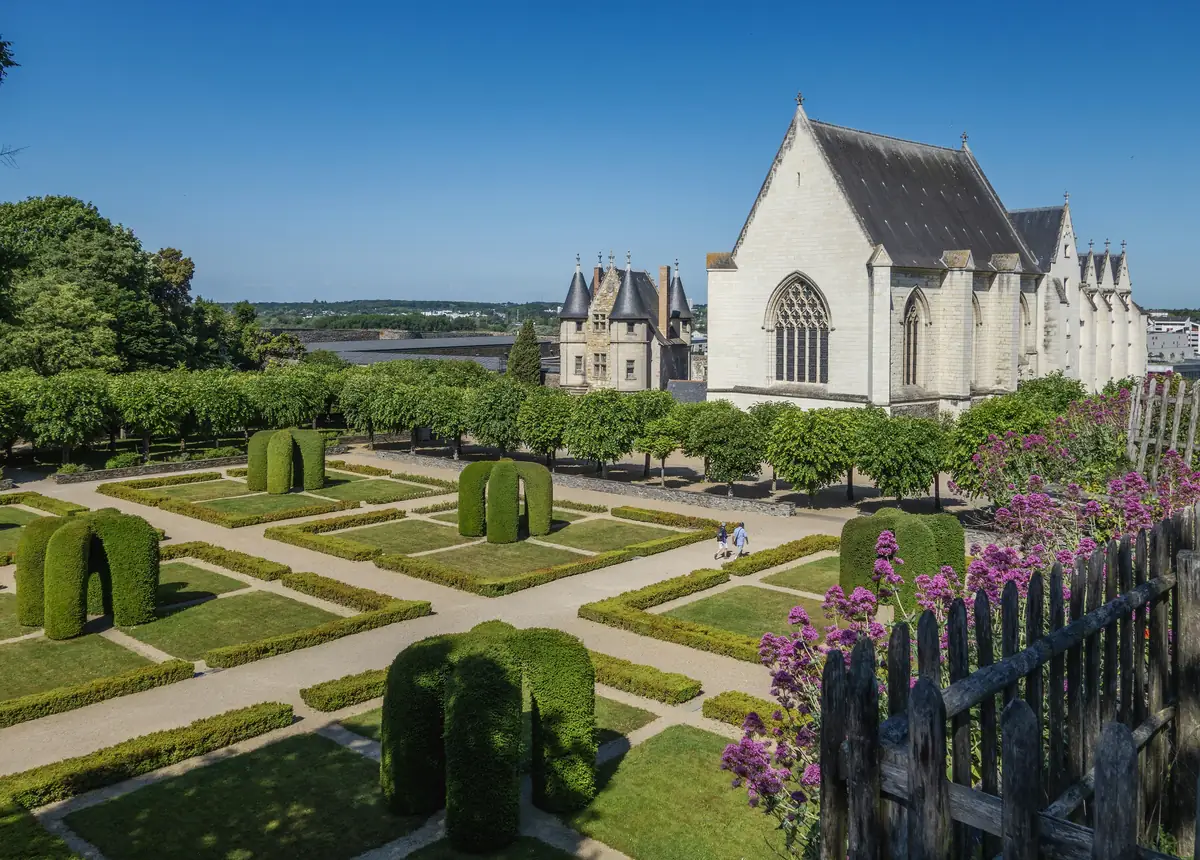
Inside the curtain wall, the mood changes entirely. A chapel built in the early fifteenth century and the former royal lodgings sit beside the towers — a reminder that this was a residence of the Dukes of Anjou as well as a stronghold. Around them run gardens: clipped yews in the courtyard, a vineyard and vegetable garden, and a hanging garden of medieval plants up on the ramparts, from where you look down on the patterned beds laid out in the dry moat. A quiet, green close to a visit that starts in a dim gallery and climbs a rampart.
Guides to the château
Inside the walls
What to see inside the Château d'Angers
The Apocalypse Tapestry, the ramparts and towers, the royal lodgings and chapel, and the château's gardens.
Read more →Planning your visit
The best time to visit the Château d'Angers
When the tapestry gallery and the ramparts are calmest, and how the seasons change the gardens.
Read more →Getting there
How to get to the Château d'Angers from Paris
The direct TGV from Montparnasse, the walk or tram from the station, and driving as an alternative.
Read more →Visiting with family
Visiting the Château d'Angers with kids
Giant towers, a rampart to climb, dragons in the tapestry, and gardens inside the walls.
Read more →Comparing Loire châteaux
Château d'Angers vs Chenonceau: which to visit
A medieval fortress with the Apocalypse Tapestry, against the Loire's graceful Renaissance château over the river Cher.
Read more →Questions about visiting
What is the château's connection to UNESCO?
The Apocalypse Tapestry housed inside the château was inscribed on UNESCO's Memory of the World register in 2023, a programme for documentary heritage that is separate from the World Heritage List. Angers itself lies near the western end of the World Heritage stretch of the Loire valley, which runs from Sully-sur-Loire to Chalonnes-sur-Loire.
How many towers does the château have?
Seventeen drum towers, each roughly 18 metres in diameter, set along a curtain wall about 660 metres around. They were raised from 1234 under Louis IX of France and give the fortress its striped, banded silhouette above the river Maine.
What is the Apocalypse Tapestry?
A monumental set of six tapestry hangings, commissioned around 1373 by Louis I, Duke of Anjou, and woven in Paris between 1377 and 1382. It illustrates the Book of Revelation in what were originally some ninety scenes; a little over 100 metres of it survives, shown today in a purpose-built gallery inside the château.
Who built the Château d'Angers?
A stronghold stood on the site from the ninth century, but the fortress visitors see today was largely raised from 1234 under Louis IX of France. It later passed to the Dukes of Anjou — Louis I among them — who commissioned the Apocalypse Tapestry.
Is the Château d'Angers worth visiting?
For anyone interested in medieval architecture or the Apocalypse Tapestry, the largest set of medieval tapestries to have survived, it is a genuine highlight of the western Loire valley, and one that's straightforward to reach from Paris by train.
How do I get to Angers from Paris?
A direct TGV from Paris-Montparnasse to Angers-Saint-Laud takes around an hour and a half, and the château is about a fifteen-minute walk from the station. See our guide to the trip for the full detail.
Was the château damaged in the World Wars?
Yes. It served as an armoury through both world wars, and an ammunition store inside the walls exploded during the Second World War, causing serious damage. The fortress has since been restored and is managed today by the Centre des monuments nationaux.
Where can I check current opening hours and admission prices?
Those details change by season, so we point readers to the château's own site rather than reprint a table here — see the link in the footer of this page.
Planning a visit?
Viator shows tour prices in your own currency at checkout; nothing is added by us.
Check availability on ViatorThe tapestry gallery and the rampart walk are usually at their busiest through the middle of the day between May and early September.